Decision Mechanics

Insight. Applied.

  • Services
    • Decision analysis
    • Big data analysis
    • Software development
  • Articles
  • Blog
  • Privacy
  • Hire us

AI worst case scenarios

June 1, 2016 By editor

toy robot eating a chocolate

The Daily Mail reports on various dystopian AI scenarios—including all humans having to have a brain implant that allows for direct mind control.

Surprisingly, there was nothing about robots coming over here, stealing the jobs and scrounging benefits—especially as it’s (kind of) already happening…well, not the benefits bit, obviously.

I’m off to kill the toaster before it turns on me.

Filed Under: Artificial intelligence

Microsoft R Open 3.2.5 released

May 30, 2016 By editor

Microsoft R Open 3.2.5 is now available.

While there are no substantial changes to core R, the CRAN snapshot includes some new packages, such as deeplearning—a deep neural network implementation for regression and classification.

Filed Under: Data science, Machine learning Tagged With: deep learning, R.Microsoft R Open

Trump and confrontation (analysis)

May 30, 2016 By editor

Donald Trump

The general consensus in the mainstream media seems to be that Trump is irrational…at least that’s how the polite ones put it. However, the provocative positions he takes may draw attention away from a rational campaign strategy.

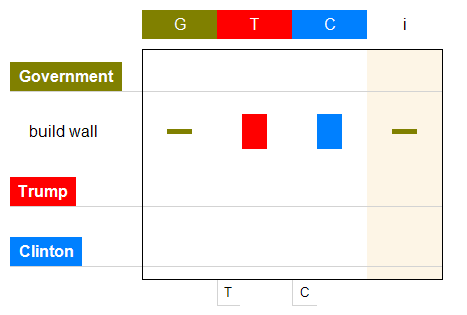
Take Trump’s famous wall. While Clinton mocks the unrealistic ambition, she doesn’t seem to disagree with the basic premise. Her position is, basically, to build a “less effective” version.

Now, that is almost certainly all that is achievable. But, via his provocative stance, Trump is drawing his opponent into a debate of his creation. Trump then takes a strong ideological position—which Clinton appears to agree with—leaving Clinton to argue logistics.

On this issue Trump and Clinton seem to agree on the idea, but Clinton wants to thrash out the implementation details in front of an easily bored electorate.

confrontation over building a US/Mexico wall

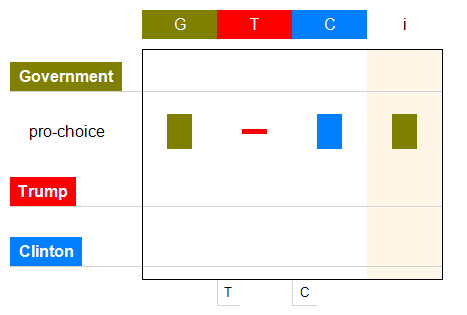
Another area where Trump’s election strategy could be seen as rational is in his evasive and off-the-cuff approach to policy areas where he has yet to stake a claim. This results in either him not showing his hand, or effectively producing random strategies—such as his views on abortion.

confrontation over abortion rights

Unpredictably can be a powerful weapon in negotiations. It hampers your opponent’s attempt to build an effective counter-strategy. The Clinton campaign is likely to have significant prowess in out-planning opponents. By keeping them guessing Trump neutralizes one of their assets.

Policies and campaign strategy are not the same thing. One can be wild while the other is planned and coordinated. Trump might be hoping commentators focus on the former and ignore the latter.

Filed Under: Confrontation analysis Tagged With: Clinton, politcal campaign, Trump

Microsoft R Server documentation is now online

May 17, 2016 By editor

The complete Microsoft R Server documentation is now available on MSDN—and is publicly accessible.

It includes comprehensive details of the RevoScaleR High Performance Analytics package. RevoScaleR includes the following analysis functions

  • rxSummary (basic summary statistics)
  • rxLinMod (linear modeling)
  • rxLogit (logistic regression modeling)
  • rxGlm (generalized linear modeling)
  • rxCovCor (covariance/correlation, with convenience functions, rxCov, rxCor, and rxSSCP)
  • rxCube and rxCrossTabs
  • rxKmeans (k-means clustering)
  • rxDTree (classification/regression decision tree modeling)
  • rxDForest (classification/regression decision forest modeling)
  • rxBTrees (classification/regression boosted decision tree modeling)
  • rxNaiveBayes (Naive Bayes classification)

Filed Under: Big data, Data science Tagged With: documentation, Microsoft R Server, RevoScaleR

Kids learn to make decisions by making decisions

May 17, 2016 By editor

Alfie Kohn is a critic of education’s fixation (in some countries) on grades and test scores.

In a 2010 article entitled “How to Create Nonreaders” he argued

When parents ask, “What did you do in school today?”, kids often respond, “Nothing.” Howard Gardner pointed out that they’re probably right, because “typically school is done to students.” This sort of enforced passivity is particularly characteristic of classrooms where students are excluded from any role in shaping the curriculum, where they’re on the receiving end of lectures and questions, assignments and assessments. One result is a conspicuous absence of critical, creative thinking—something that (irony alert!) the most controlling teachers are likely to blame on the students themselves, who are said to be irresponsible, unmotivated, apathetic, immature, and so on. But the fact is that kids learn to make good decisions by making decisions, not by following directions.

Learn by doing. It’s as true for decision-making as it is for any challenging task.

Of course, it’s not possible to practice all forms of decision-making just by making the decisions. Some decisions have big, irreversible consequences. This is why modeling and simulation are important tools in the decision-makers arsenal. Michael Schrage’s book, “Serious Play”, describes how we can generate memories of future events (scenarios) to enhance our ability to make decisions in response to complex, fast-moving situations.

Decision-making is a lifelong adventure. Improving it, as with so many skills, shouldn’t stop with school.

Filed Under: Decision science Tagged With: decision-making, education, serious play

  • « Previous Page
  • 1
  • …
  • 27
  • 28
  • 29
  • 30
  • 31
  • …
  • 59
  • Next Page »

Copyright © 2026 · Decision Mechanics Limited · info@decisionmechanics.com