Decision Mechanics

Insight. Applied.

  • Services
    • Decision analysis
    • Big data analysis
    • Software development
  • Articles
  • Blog
  • Privacy
  • Hire us

US lotteries rigged using malicious code

April 9, 2016 By editor

The Des Moines Register reports that an information security officer used malicious code to manipulate lottery results in Wisconsin, Colorado and Oklahoma.

Apparently

Examiners found out-of-place programs known as dynamic link libraries, or DLLs, that had been written onto the Wisconsin computer. The programs were designed to “redirect” a drawing if certain conditions were met…

This is a problem with applications that use common libraries (such as DLLs). It’s difficult to be sure what code is being executed.
Filed Under: Software Tagged With: fraud, lottery, random number generator

17000 UK male pregnancies reported in 2012

March 29, 2016 By editor

A 2012 study of National Health Service data in the UK found that there were

  • over 17000 male inpatient admissions to obstetric services
  • over 8000 male inpatient admissions to gynecology
  • nearly 20000 male inpatient admissions to midwifery

Before jumping to the conclusion that the UK is at the forefront of an exciting/disturbing evolutionary trend we should probably look for a simpler explanation—and it’s data coding errors.

Each procedure has an associated code and data entry errors resulted in men being assigned to female-only procedures. Obviously there are going to be all sorts of other errors, but it’s more difficult (and considerably less hilarious) to determine whether a patient actually had an ear infection when recorded as having a back problem.

This illustrates one of the biggest challenges for data science—garbage-in results in garbage-out. You can have the most sophisticated analysis algorithms available, but, if you are analyzing the wrong thing, you’ll draw the wrong conclusions.

Clearly it’s possible to perform statistical checks on the data—as the 2012 study illustrates. However, knowing that the data is wrong does little more than render it worthless. It could have, and should have, been checked at the point of entry. Simple logic in the data entry software could have checked the gender of the patient against a list of gender-specific codes and prevented the incorrect data from entering the system in the first place.

It’s always more efficient to fix data upstream.

Of course, gender checks would only catch some of the errors. Other techniques would be required for gender-neutral procedures. As I don’t know the data well enough, it’s difficult to come up with specific recommendations. However, some ideas might include the following.

  • Display the description of the code when it’s entered. If you are in a general practitioner’s clinic and “neurosurgery” pops up on the screen, you might catch that.
  • Allow a range of valid codes to be configured on a per terminal basis. If I’m in a gynecology department, assigning a flu code might be suspicious.
  • Learn what codes are entered at a given location/terminal. If I’ve never entered a dialysis procedure before, ask me to confirm it.
  • Alert me to very rare codes. What are the chances that I really have a patient with rabies in the UK?

One of the cheapest things we can do to improve the quality of data analysis is to improve the quality of data entry. Making basic checks in data entry systems is very, very far from rocket science.

Filed Under: Big data, Data analysis, Software

Microsoft R Server is now on the Microsoft Data Science Virtual Machine

March 2, 2016 By editor

The Microsoft Data Science Virtual Machine (DSVM) now comes pre-configured with Microsoft R Server Developer Edition.

As you can scale the DSVM according to your needs, this is an easy way to get going with some heavy duty R computations.

Filed Under: Big data, Data analysis, Data science, Machine learning, Software

The top three spreadsheet errors of the decade

September 12, 2015 By editor

IBM just published an article describing what they claim to be the top three spreadsheet errors of this decade—so far. Spreadsheets errors caused

  • the sale price of Tibco Software to be overstated by $100m
  • fatal errors in an oft-quoted fiscal austerity research project
  • 10,000 sports fans to miss a synchronised swimming event at the 2012 Olympics

Some companies I work with have started taking real steps to get spreadsheet anarchy under control. But, there are still way too many organizations who have yet to even understand they have a spreadsheet addiction. I even know of organizations who are still authorizing the development of new business critical Excel applications within departments lacking any IT expertise.

Insanity.

As enterprise software challenges go, this isn’t a particularly difficult one to fix—technically. It’s more of a people problem. First, many managers don’t understand that having key business processes run via locally maintained spreadsheets is a huge risk. And, when they do, they find spreadsheet owners unwilling to relinquish control.

Like any addiction, admitting to the problem is the first step on the road to recovery.

Filed Under: Software

First decision analysis tool on Apple Watch? Not really, but…

January 20, 2015 By editor

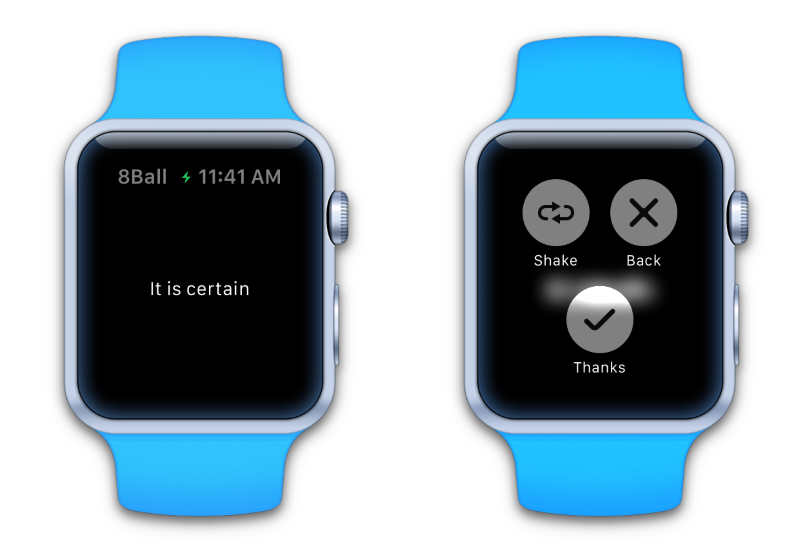
magic eight ball apple watch app

Craig Dunn has already created a decision analysis tool on the Apple Watch—a device that’s not even been launched! The ever-increasing pace of technological progress…

OK, so it’s a Magic Eight Ball fortune telling app. Not exactly the sort of thing you want to pitch to the CEO for the annual planning meeting. But, still, attempts at the real thing can’t be far behind.

The app was developed using Xamarin’s newly-released WatchKit preview—C# (or F#) on the Apple Watch.

Filed Under: Software

  • « Previous Page
  • 1
  • 2
  • 3
  • Next Page »

Copyright © 2026 · Decision Mechanics Limited · info@decisionmechanics.com